 A novel way of studying tree-dwelling animals in tropical forests could help to expand our understanding of elusive rainforest species.
A newly published paper by Edinburgh Napier University researchers analyses their work in Panama, where they used a small platform to observe nocturnal, arboreal mammals – such as sloths, opossums, porcupines, kinkajous and wild cats.
These types of animals are critically understudied because they are more difficult to observe than those that are active at ground level during daylight hours.
The study, published in the journal Mammal Research, was led by Lucy Hughes, a Visiting Fellow at ENU’s Centre for Conservation and Restoration Science and wildlife biologist with Panama-based non-profit organisation Conservation through Research, Education, Action (CREA).
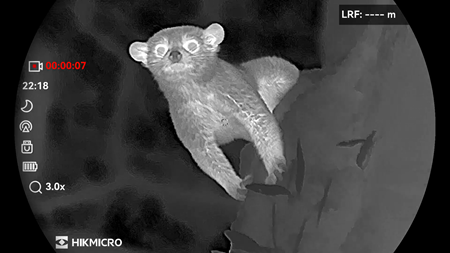
During the fieldwork, researchers set up a portable platform 12-15 metres up four different trees, and used thermal and night vision binoculars to survey in a 360-degree arc from ground to the canopy top. Climbing to the platform in the dark, Lucy and co-author Trevor Hughes worked in shifts over 12 nights to survey the wildlife.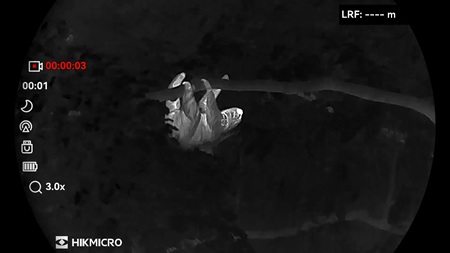
Over the course of the study, they detected 13 specialist nocturnal tree-dwelling species, more than three quarters known to be in the region – including one new to the nature reserve. Mammals often seemed to act completely oblivious to their presence, allowing them to observe natural behaviours.
This represented a large increase in the number of animals and the types of behaviour captured over a longer period of time by nearby camera-traps – which are often used to track wildlife, but have limitations when placed in trees.
The researchers believe this new method, dubbed ‘elevated nocturnal observations’ (ENO), could now be adopted to monitor nocturnal arboreal mammal populations in other tropical forest regions.
Responding to the findings, Lucy Hughes said: “We were blown away by what we saw.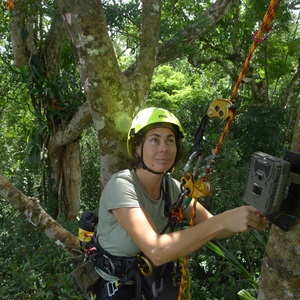
“With the thermal optics, we remained practically unseen and the ability to move meant we could follow mammals as they went about their nightly business.
“ENO shows great potential in complementing existing approaches, as it gave us rare insights into the lives of little-known species.
“In the context of the global biodiversity crisis, it offers a valuable new tool for ecologists.
“Tropical forests face an uncertain future, and we hope methods like this can help us develop robust conservation plans.”
Co-author Pat White, Associate Professor of Applied Ecology at ENU’s Centre for Conservation and Restoration Science, said: “This work is a demonstration of how innovative collaboration can help us understand more about tropical biodiversity.
“This method of studying some of the world’s most elusive animals produced remarkable results.
“As a graduate of Edinburgh Napier’s MSc Wildlife Biology and Conservation course, Lucy has shown how to make a positive difference to an important area of research.”
Pictures: An olingo (top) and sloth (middle) spotted using night vision optics. Bottom picture shows Lucy Hughes scaling a tree to reach the observation position high in the rainforest canopy.
All pictures credit: Lucy & Trevor Hughes.