Rather than experiencing museum exhibits in isolation, visitors constantly look to one another to make sense of what they are seeing
New research shows that visits to prison museums and other dark heritage sites are shaped less by labels, displays or audio guides, and more by how people experience them together.
The findings follow a recent project funded by The British Academy, which explored how people make sense of difficult heritage by examining how visitors experience exhibits at Peterhead Prison Museum in Scotland.
Led by Robert Gordon University in collaboration with Edinburgh Napier University, King’s Business School and the University of Central Florida’s Rosen College of Hospitality Management, the study found that the meaning of emotionally charged exhibits is not fixed in advance. Instead, it is created in real time through conversation, gestures, shared reactions and group dynamics. 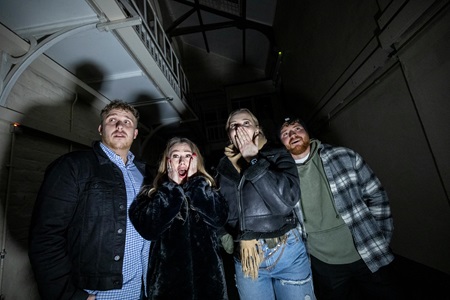
The research shows that objects associated with punishment and suffering, such as whips or prison cells, take on different meanings depending on how people engage with them together. Shock, empathy, humour, discomfort and curiosity all emerge through interaction, not just through the artefacts themselves.
In some cases, visitors use humour as a way to cope with disturbing material, while in others they align their body language or tone to signal shared seriousness or reflection.
The findings challenge the idea that heritage sites can fully control visitor experience through design alone. While interpretation panels, audio guides and layouts matter, they do not determine how people understand or feel about what they encounter. Visitors actively negotiate meaning with one another, moment by moment, as they move through a space.
The study also questions the assumption that some sites are inherently “darker” than others. What feels disturbing, shocking or meaningful varies between groups, depending on relationships, shared cultural understanding and the dynamics of the moment. In practice, the perceived darkness of a site is constantly shifting.
Co-author Professor Craig Wight, Professor of Tourism and Cultural Discourse at The Business School, Edinburgh Napier University, said: “This research marks an important milestone in a wider programme of work on penal heritage involving Edinburgh Napier University, Robert Gordon University, King’s College London, and the University of Central Florida.
“Working closely with the Cove Group, and Peterhead Prison Museum as part of that group, the study explores how visitors make sense of prison history through conversation and shared reactions to some quite challenging stories and objects.
“By using conversation analysis, we were able to offer new insight into how meaning and ethical judgement are produced in real time during museum visits.
“This work highlights why penal heritage is such an important aspect of contemporary Scottish public culture.”
Professor Dirk vom Lehn, Professor of Organisation and Practice at King's Business School, said: “Visitors constantly look to one another to make sense of what they see. These everyday interactions shape how dark an exhibit feels and what people take away.
“Exhibitions should be designed with social interaction in mind, not just individual reflection.”
Dr Rachael Ironside, Associate Professor at Robert Gordon University, said: “Dark heritage is not something people simply consume. It is something they actively perform, negotiate and co-create with others.
“Understanding this social dimension is essential for anyone seeking to present difficult histories responsibly.”
Joel Campbell, CEO, Cove Group said: “This research powerfully reinforces what we see every day at Peterhead Prison and across Cove Attractions - people do not encounter difficult history alone, they make sense of it together.
“Learning, reflection and understanding happen through shared conversation, collective emotion and group experience.”
You can read the full paper, Social Interaction and Dark Tourism in Prison Museums' in Annals of Tourism Research, on the Science Direct website.
Picture: a group of visitors at the Peterhead Prison Museum. Credit: Cove Attractions