Though she has described herself as “your average Scottish lassie with dodgy legs”, Maria Lyle is an exceptional sportswoman who became a multiple World, European, and Paralympic medallist. Her remarkable story is one of tenacity and resilience, and since retiring professionally, one of working to help others to succeed.
 “I was diagnosed at the age of two with cerebral palsy. It impacts both my legs and the right side of my body. Additionally, I struggle with processing information and becoming fatigued,” Maria explains. As a young girl she was unable to run at all and even found it hard to walk.
“Sport is an extremely powerful tool for people with disabilities; it allowed me to become a better version of myself,” she comments. That version became a two-time Paralympian, winning five medals across the Rio and Tokyo Games, and saw her gather three world titles, eight European titles, and 25 global medals in total, across the T35 100m and 200m sprint and relay events.
“As a youngster I struggled quite a lot,” Maria comments, but things changed dramatically after a school PE lesson focused on the multi-stage fitness test (‘bleep test’). Maria’s Mum, Susan, was also her PE teacher at the time: “As someone who fell over constantly, I wasn’t keen on this lesson. To everyone’s surprise, I was the last one left in the test,” Maria explains. Then, in a later PE class, she undertook a time trial running over a specified distance repeatedly: “Me, who couldn’t run at all, managed to do it, and that’s what got me started. From then on, the more I ran, the more my muscles were strengthened, and suddenly I felt like I was good at something.
By her teens, Maria had joined her local East Lothian running club and began to compete in disability events. At 14 years�old, she donned a British vest for the very first time at the IPC Athletics European Championships in 2014 and broke the world record for the 100m and 200m sprints, achieving double gold. “So, I set my sights on the Paralympic Games in Rio in 2016,” she comments, where she won bronze in both the 200m and 100m sprints and was part of the silver-medal winning 4x100m relay team. Scottish Athletics named her Para Athlete of the Year in 2015, and again in 2019 after she won two gold medals at the World Para Athletics Championships in Dubai.
In between her phenomenal running career, Maria juggled her studies for a BSc in Sport Coaching at Edinburgh Napier. “I specialised in Disability Coach Education. It was a little strange being on the other side, not being the athlete,” she comments. “The kids I coached had cerebral palsy, and other disabilities, and it was fantastic to see them achieve a breakthrough.” The experience also brought her a newfound appreciation of her own coach: “You have to work harder to figure out how to improve someone’s technique while keeping their disability in mind.”
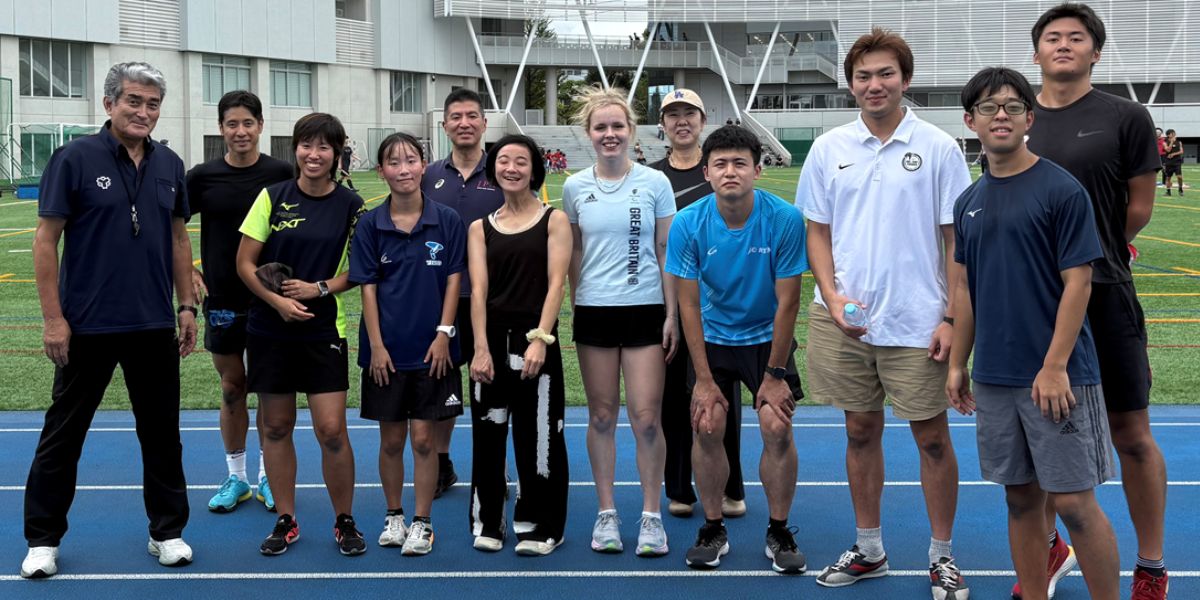
Now retired from professional running, Maria hopes to build a career in coaching. “It’s what I’ve always been interested in,” she explains. Having coached athletes in the British Athletics Futures programme, and most recently para�athletes in Japan, she is keen to do more “but as a para-athlete it’s challenging,” she adds. “There are actually very few coaches with a disability in para-athletics, and I feel there’s a disconnect about our capabilities to coach. Far more paid roles exist within able-bodied programmes, whereas Paralympics does not receive the same level of funding and the job opportunities are very limited.” Her intention is to find a way to achieve the career of her dreams.
Currently, as an Active Schools Coordinator for East Lothian Council, she works with a range of students “building relationships, understanding what young people want to get out of extracurricular sport, what barriers they might face, and how we can overcome them,” she explains. She also continues to be an advocate for mental health.
“Training and competing at an elite level is a privilege but it’s no easy ride; I suffered from anxiety, and later, was diagnosed with post-traumatic stress disorder (PTSD) as a result of my experiences in professional sport,” Maria comments. She has openly shared her recovery journey, emphasising the importance of seeking professional support, and speaks widely about her experience of disability and mental health. Her advocacy work, which has seen her support organisations such as East Lothian Special Needs Play Scheme, Oaklands School, and Support in Mind Scotland, led to her becoming the first ever Evening Times Young Scotswoman of the Year, in 2019.
Reflecting on all that she has accomplished as a 26-year-old, Maria says: “This will sound surprising, but I’m not actually super competitive, and the constant drive to be at the top didn’t really align with my values. I’m glad I’ve been able to pivot into roles where what drives me is helping others to flourish.”